

Mining Bee Sighting!
On a cool, overcast April afternoon, the forest floor of this local urban park seemed quiet. But tucked away in an open meadow bordering the woods, early-spring life was hard at work. Right there, nestled inside the delicate pink-veined petals of a Spring Beauty (Claytonia virginica), a tiny mining bee (Andrena) discovered nectar inside the ripe flower.
Field Conditions
- Date: April 4, 2026
- Species: Sweet Beauty Mining Bee (Andrena)
- Location: Bare slope in an urban park, Central Kentucky’s Bluegrass Region
- Conditions: Partly cloudy skies, low 70°F, light breeze.
Observation:
After landing on the Spring Beauty flower, this small mining bee hovered briefly before diving into the petals to collect nectar and pollen. Its presence signaled the arrival of spring and coincided with the first flush of Spring Beauty blossoms in the park.
____________________________________________________________________
Life Cycle and Habitat
What makes this specific spring mining bee so special is its highly exclusive lifestyle. This insect is a pollen specialist (oligoletic). It relies almost entirely on the Spring Beauty plant for the nectar and pollen needed to feed the next generation.
Because Spring Beauties bloom in a brief window before the forest trees leaf out completely, this bee’s entire life cycle is perfectly synchronized with the flower. Adult Spring Beauty Mining bees, solitary nesters, emerge from their underground nests just as the blossoms open. The females quickly collect pollen, dig tiny tunnels in the nearby soil, lay their eggs, and provision the nests. By the time the flowers fade into summer, the adult bee will be gone, leaving their larvae safely underground until next spring.
Social & Nesting Habits
The Spring Beauty Mining bee, a solitary ground-nester, produces one brood per year. After emerging in early spring, females construct underground brood chambers to lay their eggs and leave pollen balls to feed their young. Throughout the summer, larvae develop. When fall fades, larvae become adults and remain in their underground chambers throughout the winter. When spring arrives, they emerge as adults.
Why Specialists Bees Matter
Finding a specialist bee in an urban park shows just how resilient native pollinators can be when the right plants are available. Even a small meadow pocket of flowers next to a wooded trail can support a fragile, specialized life cycle.
Pollen and Nectar Sources
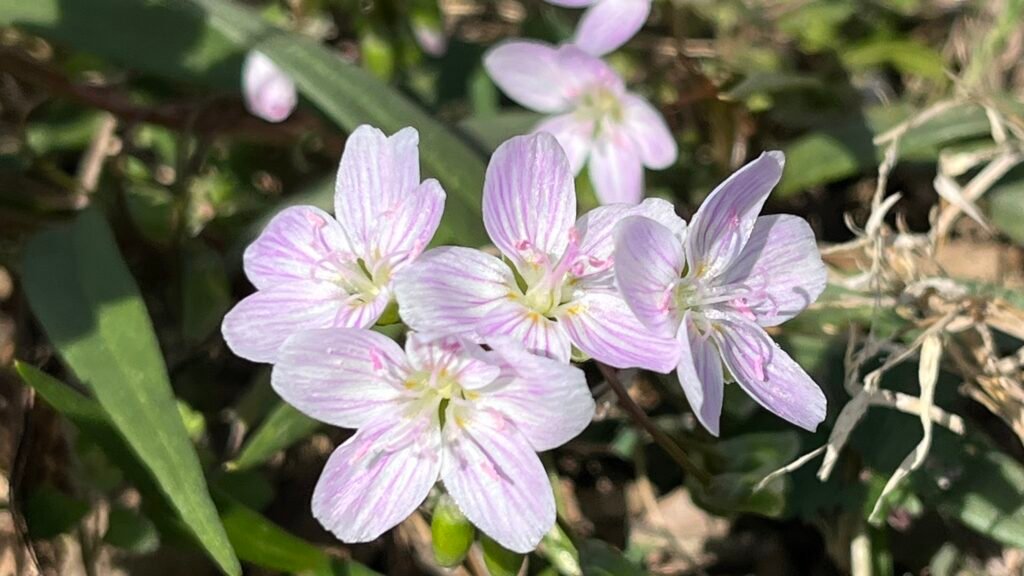
Spring Beauty Mining bees are pollen specialists. They rely on two varieties of Spring Beauty flowers for pollen to feed their young: Claytonia Virginica and Claytonia Caroliniana
____________________________________________________________________
Mining Bee Fun Facts
Pink Pollen Diet: Because the Spring Beauty Mining Bee relies solely on the Spring Beauty flower for pollen, it carries the pink pollen on its body when foraging or returning to the nest.
Ephemeral Life: Spring Beauty Mining Bees and the Spring Beauty flower coexist, both thriving for several weeks during the early spring pollinator season.
____________________________________________________________________